Tuesday, February 17, 2009

The Cuyahoga River Goes Smokin' Through My Dreams

Cleveland, city of light, city of magic. That happened to be where I spent a very romantic/patriotic Valentine's/Presidents' Day weekend. And what better time to be there than in February? It was my first time in the Forest City (I'd never heard that nickname either, until Wikipedia) and I thought I'd bring you along as I got to know the place.

My journey started with a delightful ride from Cleveland-Hopkins International Airport to Shaker Heights, where I would be staying.


On the way to the airport transit station I passed this tribute to African-American aviators, and what might be the Hubble Space Telescope. I think that's Ron McNair on the bottom left.


This was my chariot for the first leg of the journey. It was a pretty OK train and a good ride. The Greater Cleveland Rapid Transit Authority was actually named "North America's Best Public Transportation System" by the American Public Transportation Association in 2007. Too bad barely anyone rides it.


Along the train line I got to see a little of the industrial outskirts of Cleveland, whose economy thrives on the gear industry ...


The alt-erotic painting industry ...


And, as mostly seems to be the case, the abandoned buildings industry.


After a bit of a ride I got my first glimpses of the big city.


But after a transfer I was on my way back out to the east. This took me through some neighborhoods whose vitality matched that of the businesses I had previously seen.


After going through some inner-ring suburbs and seeing many vacant house lots, I made it to Shaker Square. It was the first time since leaving the airport that I saw something I would describe as "nice-looking" outside the train window, but even this one looked like it was trying too hard.


But any place that has its own House of Corned Beef can't be all bad.


This brought me into Shaker Heights, a suburb that is decidedly one of the nicer parts of Greater Cleveland but still not particularly active.


As I suspected, Cleveland is not really a walking town, but they do make some accommodations.


All right, since I already seem to be falling into the trap of characterizing Cleveland as a grim, cold hunk of urbanity, I'll spend some time showing off some of the more hip, fun hunks of urbanity to be found. This one is on Coventry Road, a cute little retail square near Cleveland Heights.


On the east side of town, a cozy little neighborhood around Tremont Street has elements that can be described as earthy ...


Lucky ...


Multicultural ...


Manly ...


Even gentlemanly.


Back on the other part of town, there are places so hip they can't tell if they're wine bars or coffee bars.


Back on Coventry, fun and moustaches are part of the scene.


Along with old hardware stores.


Happy talking vegetables.


And, again, fun.


This store actually is a lot of fun. It peddles lots of vintage 80s stuff, including Nintendo, Atari and Intellivision consoles and games. G.I. Joe seems to be a particular specialty. (Unfortunately, a few seconds after this photo was taken about half of these boxes fell off the wall.)


But the best part was that they had all of the Masters of the Universe action figures, vehicles and fortresses that I had as a kid. I hadn't seen them in years, and there they are now behind locked glass. I cried a little.


The rest of Coventry had some interesting stuff to look at. Here are some no-comment photos.


And just for fun, to say goodbye to Shaker Heights, we visit this old building with the coffee shop on the ground floor that everyone is pretty sure is a mob front.


But enough of the cute suburban stuff. Time to go downtown. (Feel free to scroll around.)


For me, downtown begins at Tower City, the place where the rapid transit lines meet – Park Street to those of us in the Metro-Boston region. But instead of coming to the surface and finding a vibrant downtown, you ascend into a mall.


The Tower City mall would be the most active place I would see during my hour in downtown Cleveland, with seemingly every office worker in town (and a few people were decidedly not office workers) spending their lunch break there. And why not? It has a fountain, a food court, a cinema, a Foot Locker, and even this walkway.


From the outside, this is what the ad poster for Tower City looks like.
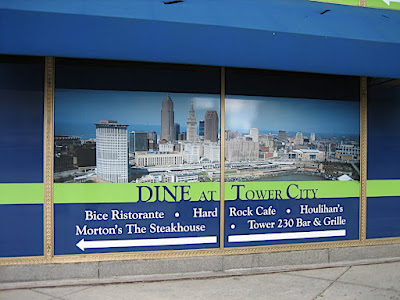


This is what I saw – I was probably just catching it at the wrong angle.


And it is in a rather spectacular neighborhood.


Just to the north of Tower City is the Public Square, which is rather scenic.


Right there in the middle is Moses Cleaveland, "Founder of the City". If I were old Moses, I'm not sure what would make me madder: a) That no one really knows who I am, despite my founding a major U.S. city, b) that they misspelled my name when they named the city after me, or c) that the city I founded, and that they named after me, is Cleveland.


From the Public Square I ventured north along Ontario Street towards the lakefront. I seemed to be the only one doing so. Granted, it was February.

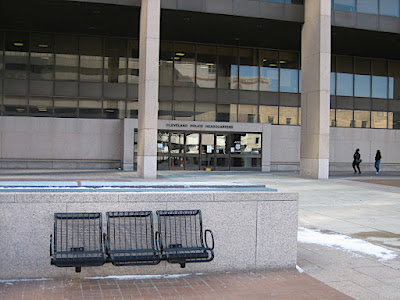


Pulaski Square, dedicated in honor of "the Poles of Cleveland", looks over the lake and all the sights along it. Of course, you still can't really get there from here.


But you can see the Browns Stadium and I believe you can walk to it via a long ramp, which I declined to use.
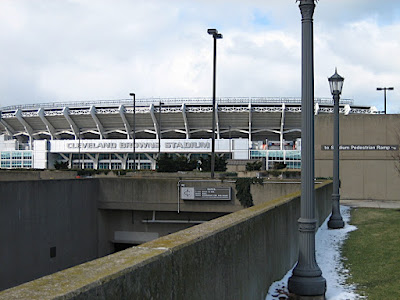


Pulaski Square also keeps the city well-defended against anyone who might want to attack the Browns, the science museum, or the Rock & Roll Hall of Fame by sea.


Alongside this little park is Cleveland City Hall, which is a more modestly sized building than I expected.


Does it say something about a city that one of its major public squares is represented by a giant rubber stamp? (And yes I did get my finger in that shot, sue me.)
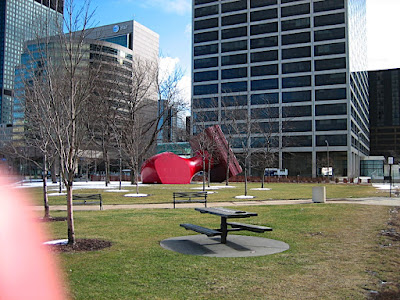


The Rock & Roll Hall of Fame was right there and so convenient to get to, with only two highways and an Amtrak line to cross. (Only one of them is an Interstate.) Again, on this particular February day, I seemed to be one of very few people making the journey on foot to see it.


Too bad I only had an hour in downtown, or I would have taken a look around. Since I had to get moving, I wandered around the lobby a bit, used the men's room, and wandered back out.


From the lakefront you get some impressive views of the city skyline. These Midwestern cities seem to take a lot of pride in their skylines. Unfortunately it tends not to be as impressive when you get up close.


Heading back through town on E 9th Street (part of which is now called "Rock & Roll Boulevard"), there are some areas where they have tried to add a touch of character, but for the most part it had a pretty grim, empty feel. Maybe it's the weather, but I tend not to think that's the only reason.


You know it's a tough town when you see public transportation being towed away.


There were some slightly warmer looking buildings, unfortunately they (like many of the buildings I saw) were largely empty.
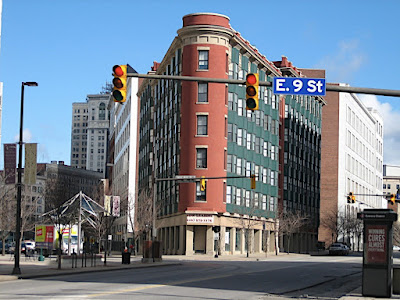


There was also one example of well-designed urbanism that belongs to, you guessed it, the Cleveland Urban Design Collaborative.


In case you can't tell what this artistic bench configuration says, it's shaped to read "WHO'S ON FIRST?"


That's right, it's Progressive Field, home of the former Jacobs Field, in turn home to the Cleveland Indians. Here is where they freeze their relief pitchers in carbonite to keep them fresh for opening day.


Unfortunately this was as close as I could get to the action.


The park seemed pretty empty but someone must be working there to update the sign.


On the other side of the field is the highway, and next to the field is Quicken Loans Arena, which I believe, by virtue of its name, makes the Cleveland Cavaliers eligible for a government bailout.


Land across the street from the arena should be a pretty hot commodity. You would think.


Plus it's located right next to the Time Warner Cable Amphitheater, which is conveniently accessible via a walkway that I was too scared to walk down even in the daytime.


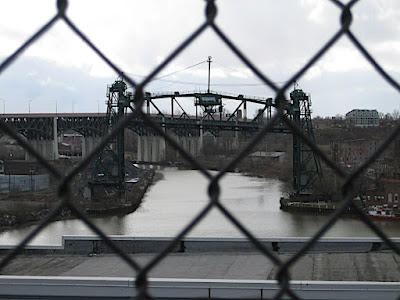
Before I left, I got the closest view I could of the Cuyahoga River. This is the river that famously caught fire in 1969, a major event contributing to the environmental movement of the 1970s. Until reading Wikipedia, I didn't realize that it actually caught fire on a fairly regular basis over the course of about 30 years. At least they got the problem fixed eventually. Now that it's relatively flame-retardant (by river standards), maybe they can make it a nicer resource for the city. Maybe.


So that was my hour and then I said adieu to Cleveland, and Cleveland said nothing in return because, clearly, it doesn't speak French.


This old rust-belt dame has seen some tough times, and surely there will be tougher times ahead given the current state of the economy. It will be interesting to see how much it grows, or deteriorates, in the coming years. While part of me is intrigued to see what opportunities the people of Cleveland will be able to create from this mess, another part of me is secretly glad I won't be there to live through it.

Saturday, January 24, 2009

E-5 ... Hit!

We're ushering in a new era in America. And in honor of our newfound hope for the future, today we take a glimpse into our nation's heroic past. This is a glimpse of a trip I took back in November, shortly after the election of our now 44th President.

I was in Charleston, South Carolina for a cousin's wedding. To be specific, I was in Mount Pleasant, which is right across from the peninsula of the city.


View Larger Map

The day after the wedding, I wanted to see some of the sights. But the day couldn't start off right without a trip to the Huddle House.


If you haven't been to a Huddle House, picture a Waffle House, and take away all of the sophistication and class. If you haven't been to a Waffle House, well, I feel sorry for you.


Yum.

So after breakfast it was off to the main attraction ... the Patriots Point Naval and Maritime Museum!


View Larger Map

This facility is best known as the permanent home of the decommissioned USS Yorktown, a World War II-era aircraft carrier that served in the PTO during the last couple years of the war and then again in Vietnam, before being deployed to retrieve the astronauts of the Apollo 8 mission in 1968. It was the tenth aircraft carrier to be commissioned by the U.S. Navy, and was called "The Fighting Lady," for reasons that are not explained on the brochure. It also appeared in the 1970 movie Tora! Tora! Tora!


As one would expect of an aircraft carrier, it's large. So large that there are in fact several museums within its expansive hull. But the really interesting things are the self-guided tours you can take of the innards of the ship's actual facilities, which have been meticulously preserved, more or less, since its decommissioning in 1970. Not everything is on a tour, but the parts of it that are are pretty cool.


My tour started on the hangar deck, about midway up the carrier, which we'll get to later. I decided to start touring the ship by going up. On the way to the flight deck I passed through the pilot's ready room, where the crews of the fighters and bombers would get instructions on their upcoming mission, and where now visiting tourists get a place to kick back and watch a little TV.


The fun of doing these tours was to stroll down the corridors, pretending that at any point I might need to respond to an attack. Anchored in South Carolina, it's hard to say who would be attacking us, except maybe some disgruntled dolphins.


Sneaking along the corridors meant that periodically I would be creeped out by the wooden people manning the control stations, including this one, the Master Indicator Control Room, just one of the many radar equipment stations I would pass on my journey.


As with most museums, they don't let you have any real fun.


And really, who can resist climbing up on one of these?


Of course, there were no posted instructions telling us we couldn't climb on the guns.


This one I don't have much comment on.


But I couldn't dally on the flight deck, partly because the sideways rain was starting to get to me. Onwards and upwards to the bridge.


It was nice to know that even in the heat of battle, the officers could enjoy a civilized cup of tea. I would probably want one too if I had to drive this thing.


I guess captain of a Navy aircraft carrier was never a career choice I considered very seriously, yet it felt pretty comfortable.


Here is where all the important flag messages came in.


I learned that even though these were tough Navy guys, they weren't ashamed to get a little assistance in the vertical transportation department. Of course, it wasn't without it's hazards, as you can see.


Back down on the hangar deck, they went all out to demonstrate the importance of aviation in the history of America and the military. This effort included a replica not just of the Wright Brothers' plane, but a replica of Orville Wright himself.


Also there were the quasi-inspiring words of Lieutenant Commander John C. Waldron. If you can't read the framed text, it says, "If there is only one plane left to make a final run-in, I want that man to go in and get a hit. May God be with us all."


Also on the hangar deck there was a plane you were allowed to climb on. When I went up there in the cockpit and started playing around with the control stick like a 6-year old boy, I could have sworn I felt some part of the plane move.


And what hangar deck would be complete without a snack bar?


The next segment of the tour involved the "living" parts of the carrier. These were the places where crew members ate, slept, and of course, washed up and shaved. This was the Navy, after all.


Of course now it includes more modern facilities.


And now, the joke that has to be made: How did the aircraft carrier's cafeteria keep its prices so cheap?


Speaking of food, the tour did contain some examples of the food that would be consumed by the crew members, including these several gallons of apple sauce. Unclear whether they added these to the tour for flavor, or if they were in fact left over from 1970.


Obviously the crew members couldn't survive on apple sauce alone. They needed a little something more. But what could do the job of satisfying over 3,000 hungry men?


Want to see what 10,000 unprocessed chocolate chip cookies look like? Why am I even asking?


And in case you need help at your next party ...


I suppose it's no wonder that the crew members found themselves here from time to time.


This sign was pretty cool. It looked like something I might see at MIT.


I also took a tour down into the belly of the beast. This is a glimpse into the engine itself. I believe this is the place where they keep the dilithium crystals.


And heavens help me if I could figure out what any of this stuff was.


It was a fun tour and just about everything was educational in one way or another, even on some topics that really had nothing to do with aircraft carriers.


And where was this educational tidbit located? You guessed it.


Who says military museum curators don't have a sense of humor?

Anyway, the carrier was enormous but I also needed to get a look at the other ships on site. This was the USS Clamagore, named of course for the cocktail often enjoyed by submarine officers after they had passed safely into international waters. Just kidding, I have no idea what or who "Clamagore" was. But the ship is a diesel-powered Guppy class sub that patrolled the dangerous depths between Connecticut and South Carolina from 1945 to 1975.


This was a much easier, much more linear tour as there is only one way in and one way out of the sub, fore to aft. It started in the forward torpedo room. Yes, those are bunks above the torpedos. Yes, the crew members slept above their torpedos. Insert your own joke here.


Again, even in the toughest of conditions, the officers still had a sense of class.


These are the so-called Captain's Quarters, which look like they could just about accommodate a quarter-captain. Ha! Ergh, sorry ...


Next up was the destroyer USS Laffey, known as the "Ship That Wouldn't Die." Sounds like a horror movie, right? Well actually, it got its name from a battle that occurred off Okinawa on April 16, 1945, in which the ship was hit by five kamikazes and three bombs, and managed to stay afloat and get away. It continued to serve the U.S. Navy until 1975.


Unclear whether this sign was installed while the ship was in service, or if it was put up after the ship was decommissioned and turned into a museum. I'm guessing the latter, based on the polite usage of "please."


One of the fun things about this particular ship's tour is that the signage is much more colorful and descriptive. Somewhat disarmingly so.


The name Laffey comes from Seaman Bartlett Laffey, who served in the Civil War. The ship includes an exact replica of what Bartlett Laffey actually looked like. That, or a department store mannequin with a mustache glued onto it.


And this is where you drive the ship.


In the navigation room, where I believe there would normally be radar equipment, there was a plotting of the positions of the aircraft that attacked the Laffey on that fateful day in April, 1945.


This one was a bit of a puzzle to me, but I'm sure someone can interpret what this signifies.


Here of course are the guns that helped the Laffey stand strong under enemy fire and survive. Here they specifically forbade climbing on the guns. In case you can't read it, the blue sign just above the bench says "KEEP OFF!"


Here was a particularly interesting part of the tour for us nerds. According to the sign, this is an actual Mark 1 computer, assembled by the Ford Instrument Company. This would make it one of the first models of digital computer ever created. Like, the kind that was invented at Harvard and programmed by Grace Hopper using one of the first compiling programming languages ever. The information they had on it was a little vague, but I'll take their word. No, I couldn't touch it.


And finally, just a little more of that colorful and poignant maritime museum curator's prose.


The day wore on so I left before checking out the other attractions, including a Coast Guard cutter and a true-to-scale recreation of a Naval Advanced Tactical Support Base in South Vietnam. Bummer! But I did get to examine an aircraft carrier, a submarine and a destroyer. All I need is a cruiser and a battleship, and I'd have a whole fleet.

God bless you, God bless the United States of America, and expect to see more on my next journey.